
The Myth of the Game Changer: Does New Recording Studio Gear Actually Make Better Music?
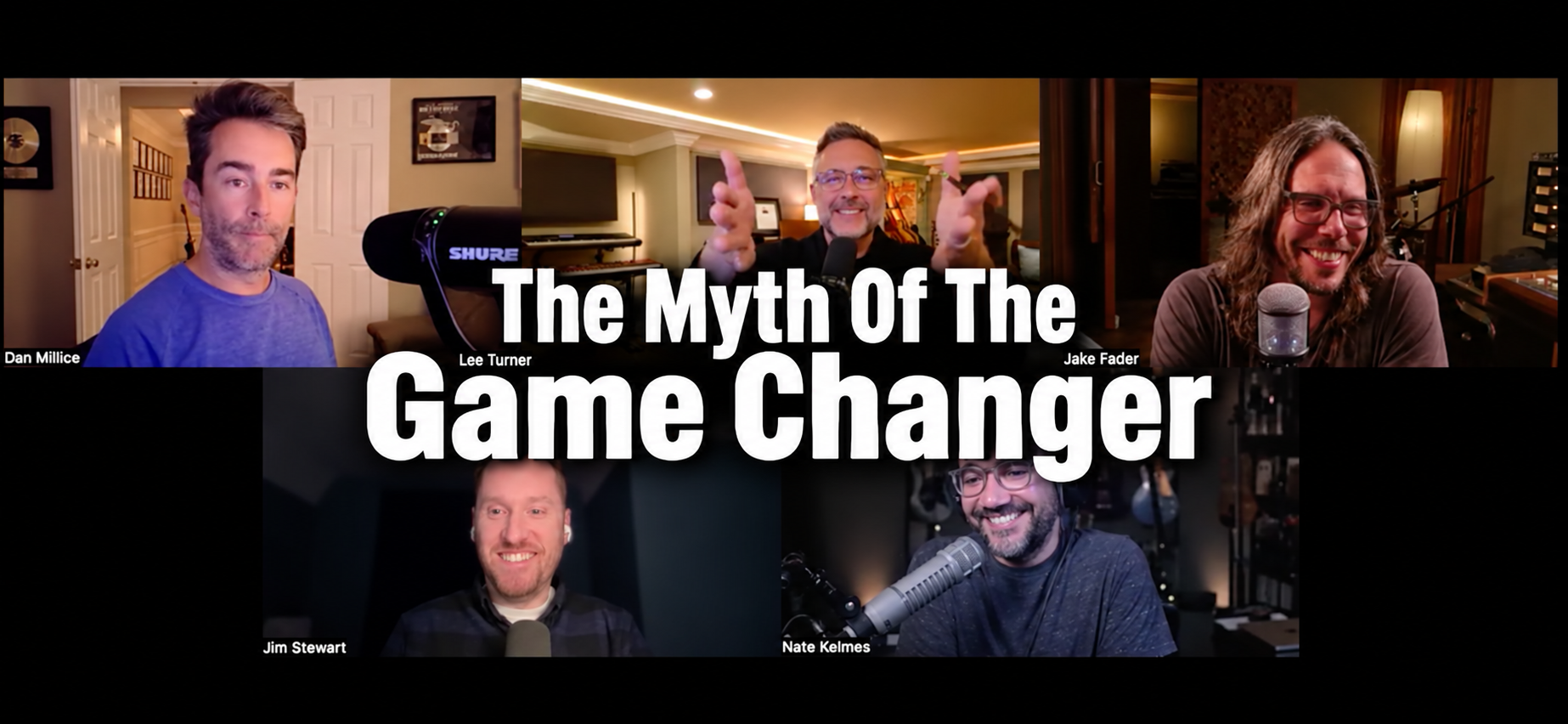
Does buying new recording studio gear make you a better producer, recording engineer, or mixing engineer? It's one of the biggest questions in music production, especially when new audio plugins, studio monitors, microphones, preamps, and recording equipment are constantly being marketed as the next big thing.
Published on November 23, 2026 | GainStage Live Session Discussion
We've all experienced it. You see a new compressor, EQ plugin, microphone, pair of studio monitors, or piece of analog outboard gear. Suddenly, you're convinced it's the missing piece in your studio.
But does new gear actually improve your recordings and mixes? Or are you simply chasing the next shiny object?
During a recent GainStage Live session, Nate Kelmes joined the team to discuss the myth of the game changer, the value of investing in recording studio equipment, and how to determine whether a new purchase will genuinely improve your music production workflow.
The conversation explored something every producer, musician, and audio engineer should consider:
The best recording studio gear isn't necessarily the most expensive gear. It's the gear that helps you hear better, work faster, remove creative barriers, and make better decisions.
What Makes Recording Studio Gear a Game Changer?
A game-changing piece of recording equipment means something different to every musician and audio engineer.
For one producer, it might be a baritone guitar that inspires an entirely new sound. For a mixing engineer, it could be a compressor that makes getting the right vocal sound easier. For someone else, upgrading their studio monitors might completely change how they approach mixing.
The value of a piece of gear depends on what you're trying to accomplish.
Nate Kelmes shared his experience during his first three to five years of mixing. He was constantly purchasing new plugins and equipment, hoping each purchase would make a significant difference in his mixes.
He would put a new plugin on a song, listen back, and think, "I still suck."
Then he'd move on to the next purchase.
It's a familiar cycle in the recording industry. We convince ourselves that better equipment will automatically lead to better results.
The problem is that buying new gear doesn't automatically improve your mixing skills, recording techniques, or musical instincts.
A new microphone won't teach you microphone placement. An expensive compressor won't automatically improve your vocal production. And a new set of studio monitors won't instantly teach you how to hear low-frequency problems.
Gear can absolutely influence your results, but understanding how to use it is what makes the difference.
How to Know If You Should Buy New Studio Equipment
Before purchasing another audio plugin, microphone, preamp, or piece of recording equipment, ask yourself a few important questions.
1. Will It Improve Your Recording or Mixing Workflow?
Sometimes the biggest benefit of new gear has nothing to do with sound quality.
It has to do with efficiency.
Take FabFilter Pro-Q as an example. Having EQ, dynamic EQ, and saturation available within one plugin can eliminate unnecessary steps and help an engineer move through a mix faster.
Jake described it as finally getting a Phillips screwdriver after years of trying to use a flathead.
That's a great way to look at workflow improvements.
If a plugin or piece of hardware helps you accomplish something faster, removes unnecessary steps, or makes your recording process more efficient, it can be a worthwhile investment.
2. Does It Solve a Specific Problem?
One of the biggest mistakes musicians and producers make is purchasing equipment without identifying what they actually need.
Before buying something, identify the problem you're trying to solve.
Are your vocal recordings too harsh? Are you struggling with low-end translation? Does your current recording setup slow you down? Are you spending too much time navigating complicated plugins?
A new tool should have a purpose.
Think about how a guitar with extremely high action makes playing difficult. Even if you love the instrument, the physical barrier can discourage you from playing.
Sometimes the best upgrade is simply something that makes creating music easier.
3. Does It Inspire You to Create?
Not every piece of recording equipment needs to solve a technical problem.
Sometimes a new instrument, microphone, or piece of studio hardware inspires you to approach music differently.
A new keyboard might lead to different songwriting ideas. An analog synthesizer might encourage experimentation. A microphone with a different tonal character might inspire a completely different vocal performance.
Inspiration is a legitimate reason to invest in equipment.
The important thing is understanding why you're making the purchase.
4. Does It Keep You Focused on the Music?
The best audio plugins and recording tools often make complicated tasks feel simple.
During our conversation, the team discussed classic hardware-inspired plugins like the Universal Audio 1176 and LA-2A compressors.
There's something valuable about a simple interface with a few controls that allow you to focus on what you're hearing instead of getting lost in endless parameters.
Sometimes fewer options lead to better creative decisions.
5. Does It Give You a Better Physical Connection to Music?
Tactile control matters.
Turning a real knob, moving a fader, playing an instrument with a great physical response, or balancing a mix with your hands can change how you interact with music.
A hardware control surface can make mixing feel more natural and efficient than clicking around with a mouse.
For some musicians, that physical connection is a significant part of the creative process.
Are Expensive Studio Monitors Worth the Investment?
If there's one category of recording studio equipment that deserves serious consideration, it's monitoring.
Your studio monitors, headphones, and listening environment influence practically every recording and mixing decision you make.
If you can't accurately hear what's happening in your mix, you're making decisions based on incomplete information.
During the GainStage session, Nate shared his experience upgrading his studio monitors. He already owned a very good pair of coaxial speakers, but after hearing a more expensive set, he decided to make the investment.
Coaxial speakers feature a tweeter mounted directly in front of the woofer, which creates a single point of sound dispersion. This alignment helps maintain consistent stereo imaging and frequency response across the listening area.
For the next two weeks, he listened to commercial records and some of his older mixes.
What surprised him was that several of his older mixes actually held up well.
That experience highlights an important point: Better studio monitors don't automatically make you a better mixing engineer, but they can give you a different perspective on the music you're working on.
However, buying expensive speakers isn't the only answer.
Your room acoustics, speaker placement, listening position, and headphones all contribute to your monitoring environment.
A great pair of studio monitors in a poorly configured room won't necessarily deliver the accurate monitoring you're expecting.
Before spending thousands of dollars on new speakers, take time to understand the room and monitoring system you already have.
Do You Need New Studio Monitors or Better Mixing Skills?
This question came up when GainStage community member Seth shared his experience mixing on inexpensive Yamaha HS5 studio monitors.
His mixes sounded great in his home studio, but when he listened in his car or on headphones, the bass was significantly louder than expected.
Was it time to spend $1,000 on new monitors, or was there something else going on?
The team's discussion offered several practical studio monitoring and mixing tips.
Expert Insight: Expert Quotes on Monitoring and Mixing
- Nate Kelmes on Learning Your Speakers: "Nate shared a story about a mix that had a buildup around 400–450 Hz. A friend sent the mix back with that area addressed, helping Nate connect that frequency range to what he was hearing in his room."
- On Reference Tracks: "A/B testing against professional tracks is one of the fastest ways to improve your mixing accuracy. Load a commercially released track in a similar genre into your DAW and compare your mix against it. This helps you identify what your ears might be missing or misinterpreting in your own mixes."
- On Multi-System Checking: "Don't rely solely on your primary monitoring setup. Check your mixes on headphones, laptop speakers, and in the car. If your bass is disappearing on everything except your studio monitors, you're likely boosting frequencies that don't translate well."
Learn Your Existing Studio Monitors
The Yamaha HS5 monitors have been used to produce countless records. Before replacing a set of speakers, spend time learning how they respond.
Nate shared a story about a mix that had a buildup around 400–450 Hz. A friend sent the mix back with that area addressed, helping Nate connect that frequency range to what he was hearing in his room.
Use Reference Tracks
A/B testing against professional tracks is one of the fastest ways to improve your mixing accuracy.
Load a commercially released track in a similar genre into your DAW and compare your mix against it. This helps you identify what your ears might be missing or misinterpreting in your own mixes.
If your mix sounds thin compared to the reference, you likely have a low-end issue, regardless of what your monitors are telling you.
Check Your Mix on Multiple Systems
Don't rely solely on your primary monitoring setup.
Check your mixes on headphones, laptop speakers, and in the car. If your bass is disappearing on everything except your studio monitors, you're likely boosting frequencies that don't translate well.
Conclusion: What Actually Makes a Difference?
The myth of the game-changing gear persists because it's easy to blame our tools for our limitations. However, the reality is that skill development matters far more than the price tag of your equipment.
Here are the key takeaways from our discussion:
- Workflow over sound: Gear that saves time and reduces friction often provides more value than gear that promises a magical sound.
- Solve real problems: Identify specific issues in your recordings before purchasing new tools.
- Inspiration counts: Equipment that motivates you to create is worth the investment, even if it doesn't solve a technical problem.
- Monitoring matters, but room acoustics matter more: Invest in understanding your space before upgrading your speakers.
- Your ears are your most important tool: No amount of equipment replaces the ability to critically listen and make informed decisions.
The best recording studio gear isn't what you buy—it's what you learn to use effectively. Focus on developing your skills, understanding your environment, and making intentional purchases that serve your creative goals. That's what truly makes a difference in your music.
Frequently Asked Questions
Is it better to invest in software plugins or hardware?
Both have their place. Plugins generally offer more flexibility and value for the money, while hardware can provide tactile satisfaction and unique sonic characteristics. The best choice depends on your workflow preferences and budget.
How much should I spend on studio monitors?
You can find excellent monitoring options at various price points. The Yamaha HS5s mentioned in our discussion are affordable and widely used. Spend enough to get accurate monitoring, but prioritize room treatment and speaker placement over price alone.
Can I improve my mixes without buying new gear?
Absolutely. Focus on learning your existing equipment, studying reference tracks, and developing your critical listening skills. Many professional records have been made with relatively modest equipment.
What's the first piece of gear I should upgrade?
This depends on your specific situation. If you're struggling with workflow, a streamlined plugin suite might help. If you're having translation issues, better monitoring or room treatment might be the priority. Identify your biggest bottleneck first.
How does AI-assisted mastering affect the need for new gear?
AI mastering tools can handle the final polish of a track, but they still require a well-recorded and properly mixed source. If your recordings are poor, AI cannot fix fundamental mistakes—meaning high-quality input gear and skills remain essential.
What are the best DAWs for integrating third-party plugins?
Modern DAWs like Ableton Live, Logic Pro, and Pro Tools offer robust plugin support. The key is choosing a DAW that allows you to organize and recall your plugin chains easily, which directly impacts workflow efficiency.
Why do reference tracks sound different on my system?
Differences in loudness, dynamic range, and frequency balance between your mix and a commercial release are common. A/B testing helps you identify these discrepancies so you can adjust your EQ and compression to match the professional standard.
0 comments